Posts

Five Star Values for Critical Incident Survival
Image
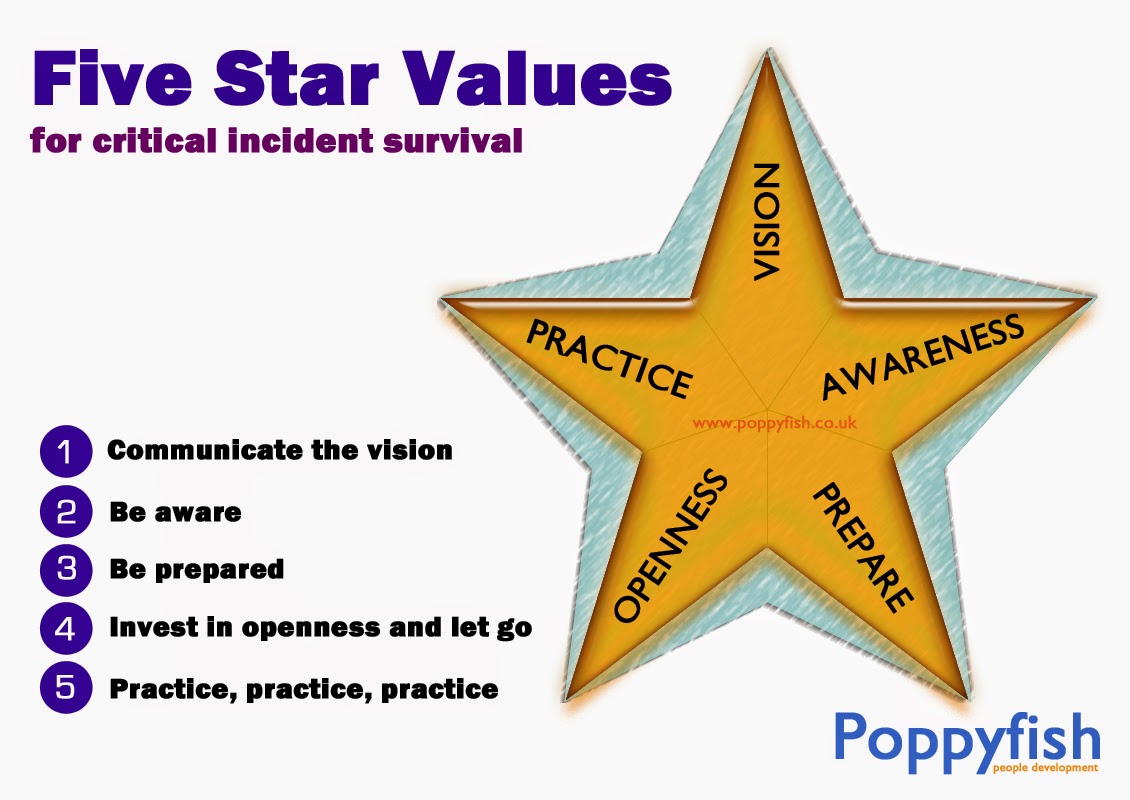
I've written and spoken about it so many times that to some people I must be starting to sound like a cracked record. But just in case this is completely new to you then let me crank the gramophone handle one more time.... The most amazing thing about critical incidents that impact organisations is not that they happen but that they do not happen more often. Turn on the news and you'll find one in an instant. Right now, somewhere in the world, an organisation is experiencing a critical incident. And you only have to look at the "Wall of Terror" below to see some potential consequences. So if there is a certain inevitability surrounding the fact that the organisation that you work in will experience a critical incident then what can leaders do to ensure that their organisation will survive?  Here's our suggested top 5 values, attitudes and behaviours: Communicate the vision Organisations that keep going through critical incidents have a strong...
Forum Theatre

Image
Old Bill Shakespeare knew a thing or two about most things, but not even he dared to combine theatre with performance management.  Forum Theatre is a style of drama pioneered by the radical, innovative and influential Brazilian dramatist Augusto Boal. First created as a way to explore how people can change the world around them Forum Theatre is used to allow audiences to take over the direction of events, allowing the audience to direct the actors in an attempt to change the outcome of events on stage. In its purest form an audience member interjects at any time in the play and steps up to take the place of the characters, or to suggest what the character should do next. The play then goes on following this new approach.  Radical? Possibly. Chaotic? Definitely. Applicable to organisational development and learning? Absolutely! At Poppyfish we can apply Forum Theatre in any context where individuals are attempting to ‘learn’ a new process or technique, especially wher...

The Culture Box

Image
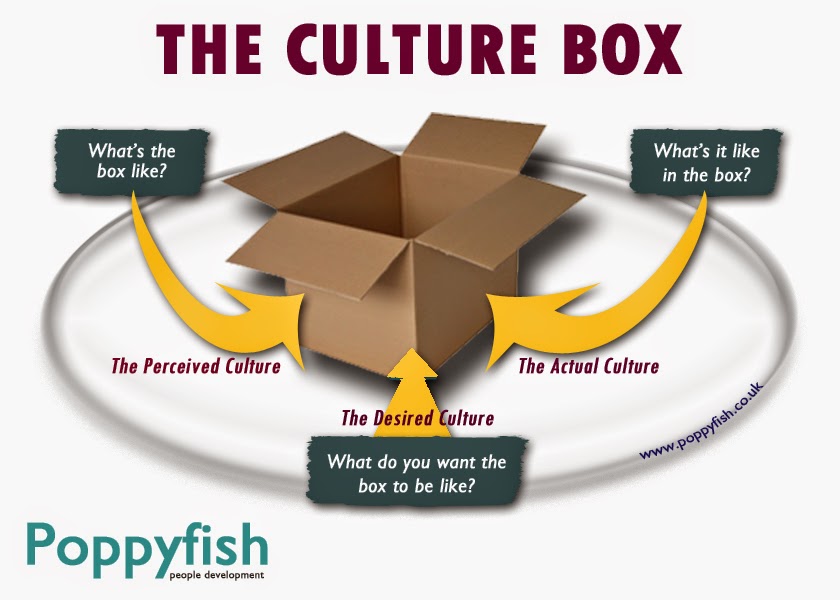
Organisational culture can be a confusing topic, especially for those who have never come across it before. Those of us who ponce around talking about leadership and organisational dynamics tend to forget that, for many, culture is a bit of a buzzword. Often, others associate culture with going to the ballet or liking opera, not to “the way we do things around here”. So to help us explore the ideas around culture with those who have never encountered it before we’ve developed the idea of The Culture Box . It works as a great metaphor for organisational culture and doubles up as a fun group exercise for teams getting started with the concept of culture.  So how does it work?  The Culture Box Exercise For this exercise you will need a large cardboard box. The larger the better. Ideally you can use one that’s large enough for one or two members of the group to sit in. Then, with the box placed in the centre of the room, enlist your volunteer(s) and sit them in the box. If ...

How we learn from critical incidents

Image
The tragic and ongoing story of Malaysia Airways flight MH370 has few positives. At the time of writing it appears highly likely that the aircraft, which disappeared on 8 March as it flew from Kuala Lumpur to Beijing, ditched somewhere in the sea off the SW coast of Australia, many miles off course  from it’s planned route. No wreckage has been found and there has been no communication with any of the 239 people listed as being on board. No reason for the massive deviation in the flight plan or the loss of communication has been provided. What continues to unfold is a fascinating and disturbing tale that has flummoxed just about everyone. But what we have already experienced as part of this story helps us expand our understanding. And here's how. As humans we rely on our skills of pattern recognition to make sense of the world around us. When stories and events unfold we look to the validity of our own experience to assess the situation against our own memory banks of data, h...

You don't have to be a Jedi to work here, but it helps

Image
We've all seen it. It's one of the most famous cinema sequences of all time. Luke Skywalker is hurtling at high speed along the narrow canyon around the Death Star. On his shoulders rests the last hope for a bright future for the galaxy. If he succeeds in targeting his torpedo on the tiny exhaust port target then the explosion will cause a chain reaction that will lead to the destruction of the Empire’s most deadly weapon. Skywalker will be a hero and his friends will live. Should he fail, his friends will suffer a terrible fate and the rebel base will be destroyed, plunging the galaxy into endless torment and suffering at the hands of the evil Emperor and his even more sinister minions. Tough call. Skywalker is piloting a state of the art space ship, crammed with targeting systems and computer guided what-nots designed by experts to maximise the chances of the all important direct hit. Others have tried to hit the exhaust port before him, but all have failed. Now, with t...

Getting started with 1-to-1s

Image
We know that if we are to make 1-to-1 meetings a habitual part of our management style then we have to get practising. But how do you get started with 1-to-1’s ? Well, try this.  Next time you are in a meeting with your team tell them that you want to give 1-to-1 meetings a six month trial. Ask each of them to take responsibility to arrange their own 1-to-1 sessions with you. Ideally these will be face to face, once a week, at a regular time if you can. Giving the responsibility for arranging the meetings to the subordinates is a great way to empower them, just make sure that you are honest with them with the booking arrangements and make sure that you honour the meetings. If you don't turn up you are letting them down and they will certainly think less of you for it. How long should each meeting be? Half an hour is fine. A general rule is 10 minutes for them, ten minutes for you and ten minutes for everything else.  Do the meetings need to be in private? Not necessa...

Trust at work...

Image
Trust is one of those core values that we like to hold dear, both at home and at work. Having trust in someone is a liberating feeling, a feeling that we know we are in good hands, no matter what happens. A feeling of something shared. The phrase “Trust me” is the ultimate statement that we use when we have tried almost every other form of reassurance, when we just know everything will be alright. So trust then, is a good thing and most of us want to see more of it. Lose trust and you lose the relationship. Anyone with a failed marriage will tell you that relationships in which trust has been lost are doomed to a miserable future. The curious thing however is that trust, like common sense, isn’t actually all that common. Especially not, it seems, in the world of work. The UK CIPD have recently published the results of a workplace survey claiming that  just over a third (37%) of employees trust their organisation’s senior management. By inference therefore the other 63% do not...

Making Time

Image
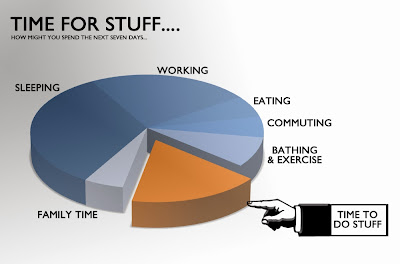
Time. It's precious. We all know that and yet many of us manage to find a way to waste it. We manage to find things to do that cost us time but give little gain. And we don't have to travel far from home to find those timewasting opportunities. Indeed, many of them are in our own homes. The TV, the Xbox, the internet. You see, the attractions of modern life make it so easy for us to waste our time, to fill large chunks of our leisure time with nothing in particular but in a way that makes it seem like we're having fun. Now, I'm no time management angel. I have all the same time management issues as the next man, but the fact is that I know that how I spend my time is a choice. I can choose to relax and spend my time scratching my backside whilst watching old John Wayne films, or I can choose to do smoothing that might be more likely to improve my life, or to improve the live of others. Maybe that would include spending time on self development or learning a new ski...
Image
Knowing the difference between effectiveness and efficiency is not always clear in the workplace. Often the two words are used interchangeably. So if we are to explore effectiveness in more detail then it is important that we draw a clear definition that allows us to differentiate between the two. Consider the following question: Which is more important; doing the right thing, or doing things right? Take a few moments to think about this. Doing things right is an important part of getting your job done. But doing the right thing might be the most important aspect of what you do .  So when it comes to working in organisations it is more important to be doing the right things than it is to be doing things right . Let me explain... Effectiveness comes from doing the right things whilst Efficiency means doing things right Efficiency and effectiveness are both important concepts, and organisations that want to be the best that they can want to achieve well in both a...

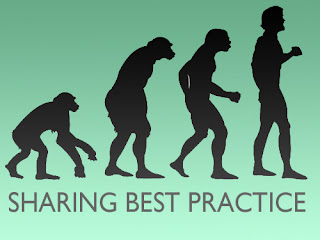
Sharing Best Practice: Learning from Ugg and Thugg

Image
The Neanderthals sat huddled round the fire. The soft orange light reflected from the walls of the large cave in which they were gathered, giving an eerie light to proceedings.   From the walls of the cave the dull handprints and paintings of the top mammoth hunters from all ancestry hung over the group, reminding them of just why they were here.      Ugg gruntedfirst. He grunted of how he and his team of hunters had worked all day to corner the great mammoth whose carcass now filled their bellies. It was the first time they'd eaten mammoth in many moons. The other hunters sat and listened as Ugg told the tale of how he, newly returned to the community from sabbatical work with the tribe on the other side of the stream, demonstrated how he had used his new "cat-a-pult" process to maximum effect to bring down the giant beast. They listened in awe. "Cat-a-pult". What a strange device.   The hunters glanced uneasily at each other as Ugg handed round the n...

Job Maps

Image
Example Job map: Building Site Manager A Job Map is a diagram, created by you, that shows the interconnections between your job and the people who have an expectation of you in your job. It can be a very helpful tool for understanding and clarifying your role and priorities at work and as a tool for problem solving. It is especially helpful when used as a tool to aid recruitment, or to assist someone starting a new job. A good job map can be used to:   Give a clear indication of key responsibilities. Make it clear to others exactly what it is that you do. Identify and tackle problem areas. Help produce a job description and be useful when setting objectives. When you combine your own map with the job maps of other people in your teams you may also be able to: Identify common problems. Highlight areas where efforts are duplicated or confused. Spot important new areas of work or gaps in existing responsibilities.   Sharing your Job Map ...

Playing in the NIAB sandpit

Image
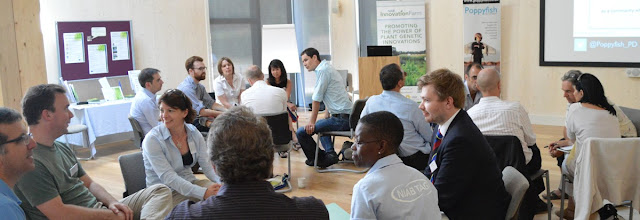
A selection of photo's from this week's sandpit with NIAB's Innovation Farm. Proof, if any were needed, that quality conversations are a great platform for sharing best practice.

Manager or Leader? The Slim View

Image
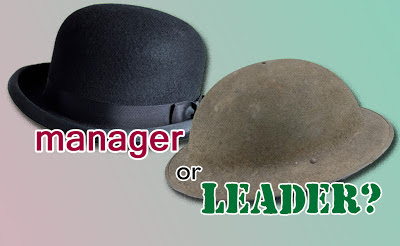
In the field of management science and in organisational development in particular we often talk about the differences between managers and leaders. Every now and then I come across great little snippets and insights from outside the field that add to the conversation. And here is one of those from the field of military history, a place to which my reading commonly wanders and where the rich tapestry of leadership is a theme that is commonly discussed. Less common though is for this field of study to throw up a direct comparison between leaders and managers.  The British General William 'Bill' Slim was the master of successful military campaigns against the Japanese in the Far East during the Second World War and the leader of what is often called the "Forgotten 14th" Army. Slim, with excellent credentials of success both in terms of strategy and leadership saw a keen difference between leaders and managers. Slim's comparison runs as follows: "The lea...

Left brain? Right brain? Change the paradigm

Image
Technical excellence. You strive for it, you study for it. Ever since that first day at school when they opened the top of your head and started pouring in all those facts, algorithms, rules, dates, ratios, laws and equations you have been building the extreme specimen of technical genius that you are today. Technical knowledge is essential, it is the bedrock of our physical world, and for year upon year you have strived to improve your mastery of it. Technical excellence is important for all sorts of reasons, but at the most basic level it is important because it gives us power. It gives us power to speak with authority on our chosen area of excellence. It gives us power to get our foot in the door of that job we are seeking, it gives us power to earn reward and recognition, and it gives us power over other people. Neuroscientists are technical experts. They have power over me. The power I assign to them means that I believe them when they talk to me about the way the brain ...

Understanding SPECTRUM

Image
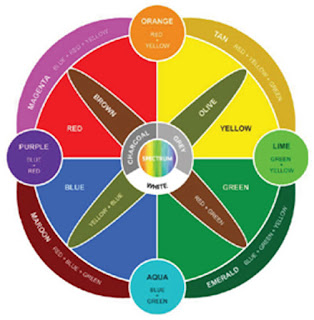
This blog post is in support of the SPECTRUM evaluation tool available online from www.evaluationstore.com . Although just one of a number of profiling tools available, SPECTRUM was initially designed for Evaluation Store by Poppyfish Associate Steve Jarrett and benefits from being one of the more affordable profiling tools for those taking their first steps with this approach.   What is SPECTRUM? One of the key ways that learning and development programmes can promote organisational development is through changed individual behaviours. As we develop new skills and new awareness so we change our behaviour to achieve better outcomes. The SPECTRUM™ questionnaire provides you with valid information about your own behavioural preferences and your impact on the people around you.   What is behaviour? Behaviour can be defined as the combination of what you do, what you say, how you say it and what facial expressions and body language you use in the process. ...