Posts

Showing posts with the label learning

Forum Theatre

Image
Old Bill Shakespeare knew a thing or two about most things, but not even he dared to combine theatre with performance management.  Forum Theatre is a style of drama pioneered by the radical, innovative and influential Brazilian dramatist Augusto Boal. First created as a way to explore how people can change the world around them Forum Theatre is used to allow audiences to take over the direction of events, allowing the audience to direct the actors in an attempt to change the outcome of events on stage. In its purest form an audience member interjects at any time in the play and steps up to take the place of the characters, or to suggest what the character should do next. The play then goes on following this new approach.  Radical? Possibly. Chaotic? Definitely. Applicable to organisational development and learning? Absolutely! At Poppyfish we can apply Forum Theatre in any context where individuals are attempting to ‘learn’ a new process or technique, especially wher...
The Culture Box

Image
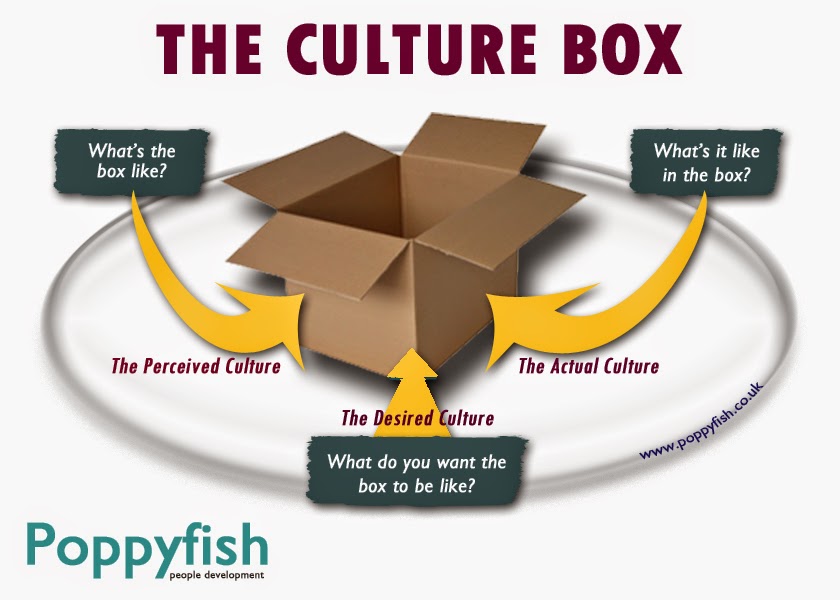
Organisational culture can be a confusing topic, especially for those who have never come across it before. Those of us who ponce around talking about leadership and organisational dynamics tend to forget that, for many, culture is a bit of a buzzword. Often, others associate culture with going to the ballet or liking opera, not to “the way we do things around here”. So to help us explore the ideas around culture with those who have never encountered it before we’ve developed the idea of The Culture Box . It works as a great metaphor for organisational culture and doubles up as a fun group exercise for teams getting started with the concept of culture.  So how does it work?  The Culture Box Exercise For this exercise you will need a large cardboard box. The larger the better. Ideally you can use one that’s large enough for one or two members of the group to sit in. Then, with the box placed in the centre of the room, enlist your volunteer(s) and sit them in the box. If ...

How we learn from critical incidents

Image
The tragic and ongoing story of Malaysia Airways flight MH370 has few positives. At the time of writing it appears highly likely that the aircraft, which disappeared on 8 March as it flew from Kuala Lumpur to Beijing, ditched somewhere in the sea off the SW coast of Australia, many miles off course  from it’s planned route. No wreckage has been found and there has been no communication with any of the 239 people listed as being on board. No reason for the massive deviation in the flight plan or the loss of communication has been provided. What continues to unfold is a fascinating and disturbing tale that has flummoxed just about everyone. But what we have already experienced as part of this story helps us expand our understanding. And here's how. As humans we rely on our skills of pattern recognition to make sense of the world around us. When stories and events unfold we look to the validity of our own experience to assess the situation against our own memory banks of data, h...

Durkan LEAD

Image
Poppyfish People Development is pleased to be partnering the construction company, Durkan Limited, in its new LEAD initiative which gets underway in June. The company wide Durkan LEAD programme will see all 160 employees embark on a pathway of learning and development that is designed to maximise individual potential and generate continuous performance improvement across the firm. Each Durkan employee will be enrolled on one of three learning pathways, each following a personalised structure that will see a number of compulsory events supplemented by additional optional events that the employee can choose to attend. Employees that complete all compulsory courses and an appropriate number of optional courses will be entitled to receive a 'Durkan Diploma' in recognition of their learning. “ We are very pleased to be able to offer this exciting new opportunity to our staff ,” said Ian Cresswell, Director of Health & Safety, Quality and Environment at Durkan, “ we fee...

Pandemic Simulator

Image
Pandemic is a Poppyfish business simulation and management learning exercise designed to help organisations to understand the possible consequences of an outbreak of pandemic flu. The simulation involves participants managing a number of realistically structured and interactive departments, business units or teams through a pandemic cycle, juggling resources to maintain operations and deliver objectives. Run as a one day phased decision making exercise Pandemic uses data on infection rates from the UK Dept of Health and NHS but is tailored specifically to the organisational hierarchy of the client organisation. Learning objectives The learning objective of this simulation is that by the end of the session participants will have negotiated their organisation through a 15 week pandemic cycle and will understand more about the impact that an event such as a pandemic flu outbreak could have on their workplace. The simulation is primarily about strengthening organisational resilience ...

Behaviour Change - old habits die hard

Image
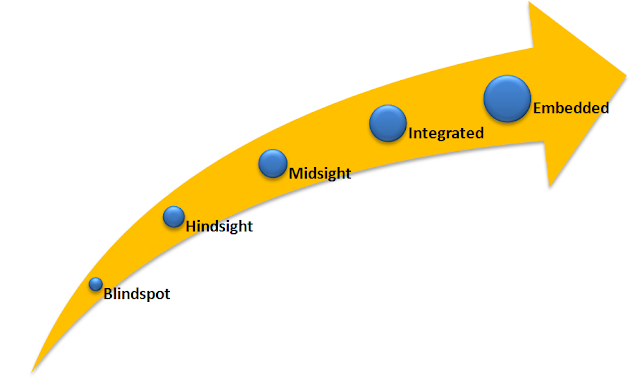
Ever wondered why giving up that bad habit is so hard? This short entry looks at behavioural change and is driven by a piece of work I have been doing with one of my clients. Our habits – good and bad - are embedded behaviour that we have been slowly adapting throughout our lives. Changing habits is difficult and requires commitment. There is a saying that habits cannot be thrown out of a second floor window. Instead, they must be coaxed patiently downstairs and out through the door. This takes time, and it takes application. But above all else, it needs us to realise that change is needed.   The change curve diagram on this page (with kudos to Martin Saville who first ran through this with me as I began my own change journey) shows us the path of behavioural change. To complete any behavioural change we must move from being unaware of the need to change, and on through a commitment to change towards a complete embedding of the new behaviour. Easy eh? ...

BC: The Smell of Fear

Image
Thinking things through with the help of a fully charged "Cogitator" Where were we? A couple of posts ago I put on “the cogitator” to consider the idea that Business Continuity (BC) and Organisational Development (OD) shared similar goals. In this post I muse on why it is that in many organisations BC can often appear to have more buy-in than OD. The victory of BC Business Continuity, with its emphasis on systems resilience perhaps pays testimony to the general victory of thinking over feeling when it comes to achieving strategic buy in to an activity. Ask an executive to reach for his Business Continuity Plan and you may well find he can locate a copy within reach of his desk, or perhaps on a memory stick or even available to him in a virtual cloud. He will have seen it, will probably have been involved in the shaping of it, and may even have tested it through an exercise or simulation. Ask the same executive to show him the organisational development or L...

OD Consultant? What's that?

Image
A  few weeks ago I had to renew an insurance policy using a new online form. One of the questions the website wanted me to answer was " What is your job ?". Next to the question was a drop down list on which there were, quite literally, hundreds of options. The list included some familiar occupations: Accountant, Actuary, Receptionist, Welder, Priest, Car Mechanic and Quantity Surveyor, etc were all listed. Scattered among them were a host of other more unusual ways to earn a crust including: Axeman, Astronaut, Chicken Chaser and Chicken Sexer.  I was so absorbed by some of these the amazing sounding jobs that I must have I scrolled up and down the list over a dozen times. I was amazed at its thoroughness. It seemed that just about every profession, or in some cases, bizarre fetish, that you could imagine, was listed.   But Organisational Development Consultant wasn't on the list.   T he suggestion that there are more astronauts tha...